

Akiyama Takashi Poster Museum Nagaoka

Akiyama Takashi: Messages Conveyed in Vivid Color

Akiyama Takashi (1952–2022) was a graphic artist known for his vibrant color posters that blend humor and social commentary. Akiyama was born in Nagaoka to a family of greengrocers. He was educated at Tama Art University and Tokyo University of the Arts and later became a professor of graphic design at Tama Art University. His work is characterized by the use of only a few colors in each piece—a style he was inspired to adopt by plaster relief paintings he had seen as a child at the Kina Saffron Liqueur Brewery in Nagaoka’s Settaya district. Many of his posters drew attention to contemporary causes and conveyed strong anti-war and pro-conservation messages. He also produced numerous posters of Nagaoka landmarks.
Akiyama won a number of awards in international art and design competitions, and he served as a judge at poster exhibitions worldwide. In 2009, he opened the Takashi Akiyama Poster Museum Nagaoka in a former bank building in his hometown, and he devoted himself to fostering young artists through events, research, and exhibitions. Akiyama left his museum to the city upon his death for the continued support of art appreciation and scholarship.
Akiyama won a number of awards in international art and design competitions, and he served as a judge at poster exhibitions worldwide. In 2009, he opened the Takashi Akiyama Poster Museum Nagaoka in a former bank building in his hometown, and he devoted himself to fostering young artists through events, research, and exhibitions. Akiyama left his museum to the city upon his death for the continued support of art appreciation and scholarship.
The Museum

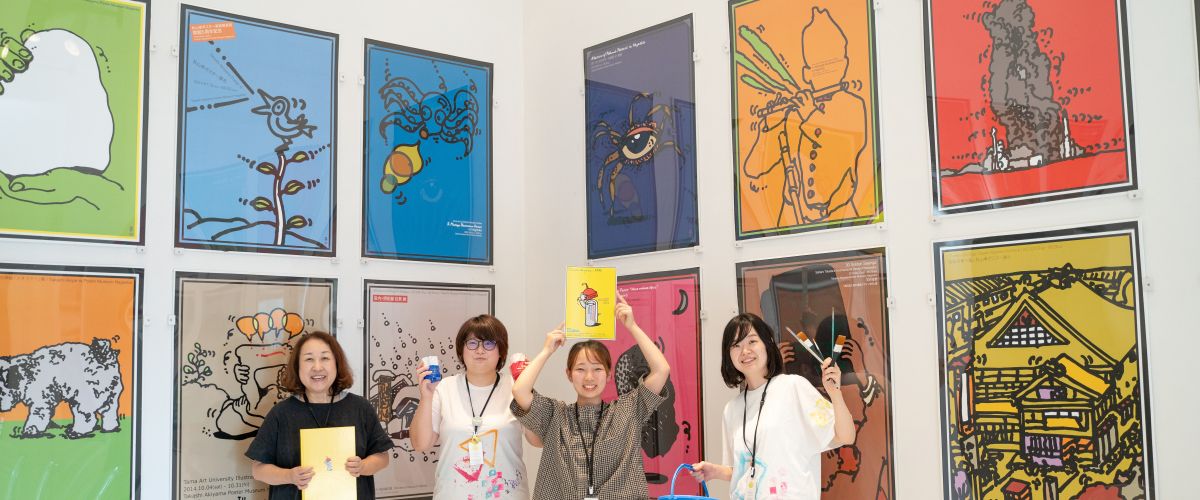
The interior was remodeled to display Takashi Akiyama’s work in a 5-meter-high gallery space. The walls are covered with posters, and tables in the center of the room display catalogs of past exhibitions. During exhibitions, the layout may change to accommodate other pieces, including three-dimensional works. The museum is open from 9:00 a.m. to 5:00 p.m. (closed on Tuesdays), and admission is free. Photography is allowed.
Thick vault doors—a remnant of the building’s time as a bank—separate the gallery space from a small gift shop and café space. The gift shop sells books and small souvenirs, including postcards with Akiyama’s colorful depictions of Nagaoka scenery and fauna. The café offers a simple menu of drinks and ice cream.
Thick vault doors—a remnant of the building’s time as a bank—separate the gallery space from a small gift shop and café space. The gift shop sells books and small souvenirs, including postcards with Akiyama’s colorful depictions of Nagaoka scenery and fauna. The café offers a simple menu of drinks and ice cream.
The Former Bank Building

The museum occupies the former Nagaoka Commercial Bank (later the Daishi Hokuetsu Bank), which was erected in 1925. The building is a registered Tangible Cultural Property typical of the Western-inspired architecture of the early twentieth century. It was built using reinforced concrete with a steel truss roof and tiled exterior walls that imitate bricks. On the south side of the building, thick glass windows that were damaged in the 2004 Chuetsu earthquake have been preserved beneath new panes as a testament to the building’s survival. On the north wall, there are faint stains from fire damage that occurred during the World War II firebombing of Nagaoka. At that time, most of the buildings surrounding the bank were made of wood, enabling the flames to spread easily as the fire moved toward the Settaya district. It is said that the less-flammable bank served as a firewall, helping to preserve Settaya and its centuries-old traditional businesses from heavy losses.