

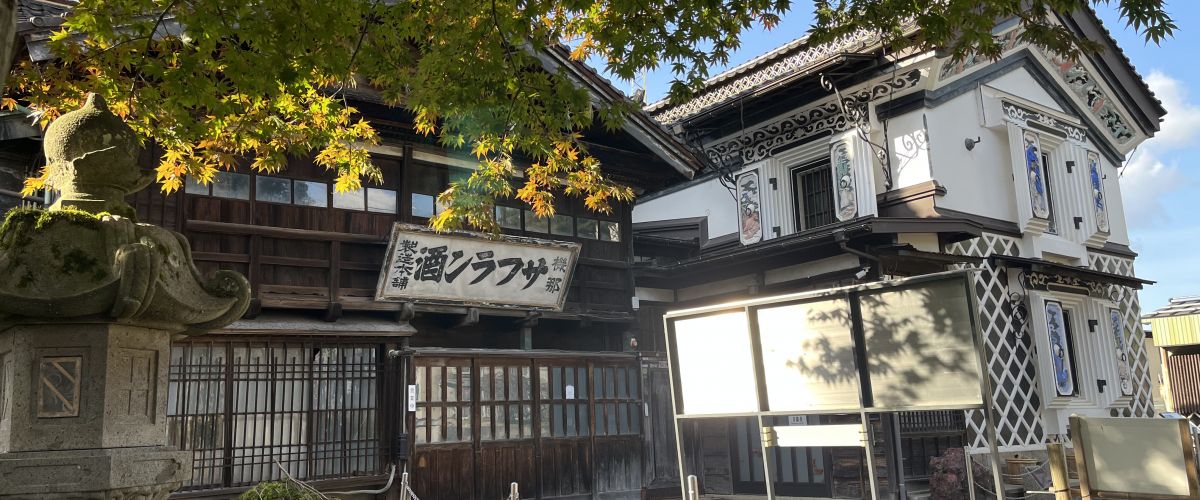
Former Kina Saffron Liqueur Brewery

The former Kina Saffron Liqueur Brewery has been a fixture of the Settaya district since its construction in 1894. The brewery began with production of medicinal alcohol and herbal medicines. At the height of its popularity in the early twentieth century, the saffron liqueur produced at the brewery was sold across Japan and as far away as Hawai‘i. Today, the remaining buildings and garden are preserved as a registered Tangible Cultural Property, and former warehouses have been converted into spaces where visitors can learn about the history of the site and shop for locally produced foods. The founder, Yoshizawa Nitaro (1863–1941), was known for his eccentric tastes and grand vision, which transformed what could have been a utilitarian facility into a complex that blended a practical work environment with lavish and colorful expressions of his many creative hobbies.

The Founder

Yoshizawa Nitaro was the second son born to a family of farmers in Jomyo Village (present-day Miyauchi district, Nagaoka). At the age of 17, he began working at an apothecary, where he learned about Chinese herbal medicines. At 21, he began peddling homemade batches of saffron liqueur in simple bamboo tubes as a medicinal elixir, claiming the recipe was a long-kept family secret. In 1887, when he was 24, he obtained a license to manufacture and sell the liqueur, which he trademarked as “Kina Saffron Liqueur” in 1892. His business grew, and in 1894, he moved his shop from Jomyo to its present location in Settaya. Over time, he used the wealth he amassed to fulfill his boyhood dream of constructing a large brewery and residential compound, while also pursuing hobbies such as landscaping, coin and sword collecting, and making fireworks.

Nitaro passed away in 1941 at the age of 78. Nearly a century later, his influence remains a strong presence in the buildings of the Kina Saffron Liqueur Brewery—a place so imbued with his personal character it came to be known as “Nitaro’s world.”

Characteristics of Saffron Liqueur

Kina Saffron Liqueur is a syrupy drink produced by steeping saffron and a variety of other medicinal herbs and spices in distilled alcohol. The modern iteration is a flavored liqueur that uses saffron, honey, jujube, clove, cinnamon, licorice, and caramel to replicate the original taste. It has a 14-percent alcohol content and is slightly thick and sweet, with a floral fragrance. The liquor can be enjoyed straight, with lemon juice, or in mixed cocktails. Though it was once widely available, it is now primarily sold in the Nagaoka region.

The Main House (Omoya)

The original structure was built in 1894 as a combined shop and residence. In 1913, an addition to the back of the building expanded it to over 330 square meters. The shop was in the front, marked by a large sign above the door, while the family’s luxurious living quarters were in the rear. The building was constructed to withstand the heavy snowfall common in the region; consequently, the gabled roof can support its particularly large decorative tiling. The house was connected via roofed corridors to nine other buildings on the property.

The Annex (Hanare-zashiki)

The two-story annex was added to the property in 1931 and was used primarily for entertaining and hosting guests. Decorative ceramic tiles on the main ridge of the roof create a traditional geometric “seven treasures” pattern, which represents prosperity. The ends of the ridge were decorated with tiles shaped like auspicious dragons and carp, along with fish-like mythical creatures that are said to ward off fire.

The interior has corridors floored with solid zelkova (keyaki) wood, elegant alcove pillars, fine tea house-style paulownia roofing, wooden partition panels of complex kumiko latticework, carved transoms, a Western-style marble sink and ceramic toilet, wooden panel paintings of animals and plants, and other expensive design elements. Folding screen paintings, works of calligraphy, wall scrolls, and other pieces of art owned by the Yoshizawa family are displayed throughout the annex.

The first floor of the annex may be viewed as part of a tour that is available on weekends and holidays. Tours are conducted in Japanese. Please contact the facility in advance to inquire about tours in other languages.

The Garden

Much like the rest of the complex, the garden reflects the personal touch of the brewery founder. Yoshizawa Nitaro was involved in the garden’s design, décor, and maintenance, and he tended to it until the end of his life. Although the overall design is typical of a traditional Japanese garden, it has several unconventional touches, including lanterns and statues sculpted by Nitaro himself and an Italian-style grotto made with volcanic rock imported from Mt. Asama in Nagano Prefecture. Other ornamental rocks are placed throughout the garden, and several ponds contain colorful nishikigoi carp. A distinctive carp-shaped fountain with a 10-meter-tall spout and other pieces were removed when metal-collection orders were issued during World War II, but the garden still retains traces of its unique character.

Other Areas of the Grounds

While the main building, annex, garden, and decorative storehouses are located on the southeastern side of the property, the northeastern side was used for production, with storehouses for rice, tools, and other goods arranged around a large building where saffron liqueur and wine were produced. Today, the former rice storehouse (komegura) is a gallery, shop, event space, and tourist information center. Visitors can attend guest lectures, learn about food production in Settaya, and purchase various locally made products, including the famous saffron liqueur.