

Former Kina Saffron Liqueur Brewery: Kote-e Storehouses
The grounds of the former Kina Saffron Liqueur Brewery contain two decorated storehouses with elaborate plaster relief paintings known as kote-e (“trowel pictures”). Kote-e were first popularized in the mid-nineteenth century. Using traditional plastering trowels, the artist builds up layers of wet plaster and sculpts it into three-dimensional shapes that can be painted when dry. The kote-e at the Saffron Liqueur Brewery were created by a local plasterer named Kawakami Ikichi, who was a frequent visitor to the brewery.
Both storehouses are registered Tangible Cultural Properties.

The Clothing Storehouse (Ishogura)

The ishogura (“clothing storehouse”) was the first of the two decorated storehouses to be built on the Kina Saffron Liqueur Brewery property. It was constructed in 1916 to store various household items. The two-story storehouse has steel plate siding, which would have been an expensive import at that time. The window shutters have kote-e depicting birds, fish, and mythical turtle-like creatures dancing on ocean waves. Another detail that reveals the founder’s playful artistic spirit is the stone tile at the base of the storehouse that can be slid open for ventilation. The handle for moving the stone is in the shape of a glass bottle in a nod to the brewery’s saffron liqueur.
The Kote-e Storehouse (Kote-e-gura)

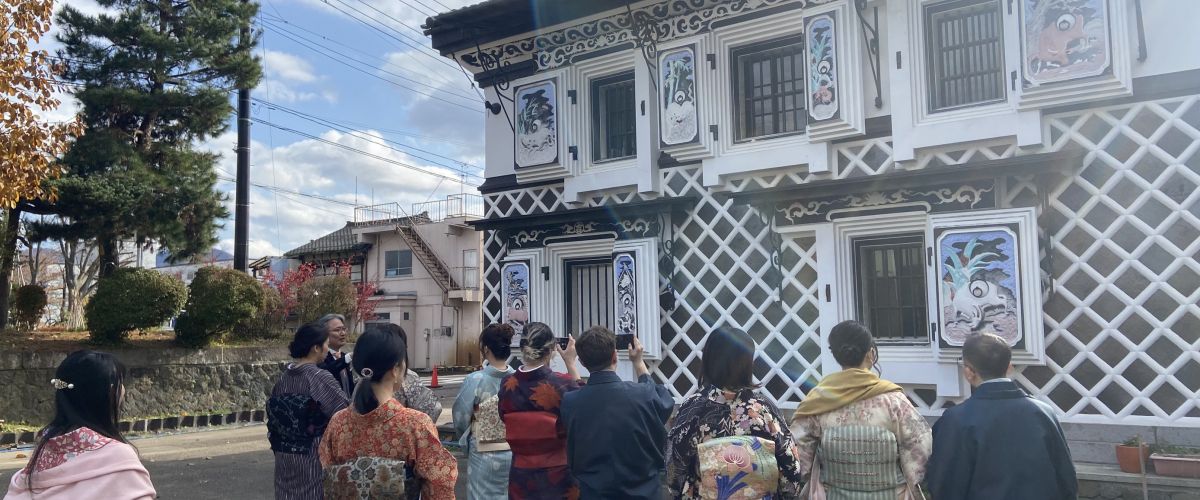
This two-story storehouse was built in 1926 with the express purpose of displaying plaster relief craftwork. Eighteen kote-e decorate the storehouse: twin dragons flanking the Yoshizawa family crest beneath the eaves of the roof; window shutters with 9 of the 12 Chinese zodiac animals along with seasonal flowers and plants; four window shutters with mythical creatures; a pair of hinged doors depicting Ebisu and Daikokuten, gods of luck and prosperity; and a pair of sliding doors decorated with cranes and turtles, which are symbols of longevity.
The founder spared no expense when commissioning the storehouse décor, considering that the artwork attracted attention from passersby and advertised the business’s prosperity. The kote-e are brightly colored and vibrant, and glass eyes were added to some of the sculpted creatures to enhance realism. The reliefs stand out against the storehouse walls, which are white plaster on the upper half and black slate tile with white seams on the lower half, a common style for fireproof storehouses. The thick, rounded white seams were said to resemble sea cucumbers, which led to the architectural feature being called namako kabe (“sea cucumber walls”).
Some architectural standards for storehouses were adjusted for the sake of the artwork. Pillars inside were positioned so as not to interfere with the placement of the kote-e. Though practical use of a storehouse generally requires closing the shutters, they are kept open on the Kote-e Storehouse to prominently display the artwork. According to local legend, the shutters have been closed only once, when the family shut them to protect the kote-e before temporarily fleeing the complex during World War II firebombing.
The inside of the Kote-e Storehouse has been converted into a display space dedicated to the history of the Kina Saffron Liqueur Brewery and the Yoshizawa family. Visitors may enter freely, and those who wish to learn more may participate in tours that are offered on weekends and holidays. Tours are conducted in Japanese. Please contact the facility in advance if you require other language support.
The founder spared no expense when commissioning the storehouse décor, considering that the artwork attracted attention from passersby and advertised the business’s prosperity. The kote-e are brightly colored and vibrant, and glass eyes were added to some of the sculpted creatures to enhance realism. The reliefs stand out against the storehouse walls, which are white plaster on the upper half and black slate tile with white seams on the lower half, a common style for fireproof storehouses. The thick, rounded white seams were said to resemble sea cucumbers, which led to the architectural feature being called namako kabe (“sea cucumber walls”).
Some architectural standards for storehouses were adjusted for the sake of the artwork. Pillars inside were positioned so as not to interfere with the placement of the kote-e. Though practical use of a storehouse generally requires closing the shutters, they are kept open on the Kote-e Storehouse to prominently display the artwork. According to local legend, the shutters have been closed only once, when the family shut them to protect the kote-e before temporarily fleeing the complex during World War II firebombing.
The inside of the Kote-e Storehouse has been converted into a display space dedicated to the history of the Kina Saffron Liqueur Brewery and the Yoshizawa family. Visitors may enter freely, and those who wish to learn more may participate in tours that are offered on weekends and holidays. Tours are conducted in Japanese. Please contact the facility in advance if you require other language support.