

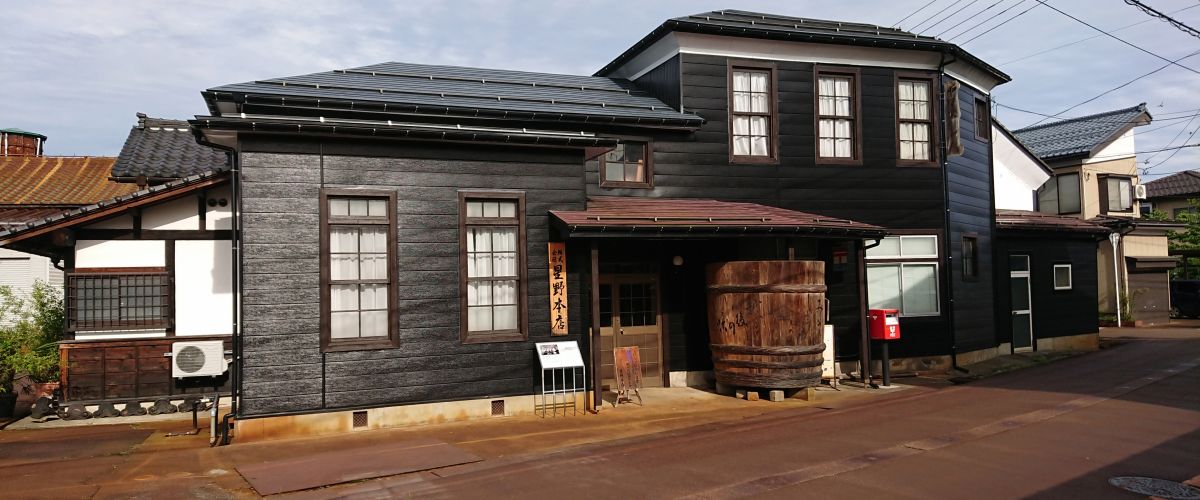
Hoshino Honten Fermented Foods
Hoshino Honten is a producer of fermented foods such as soy sauce, miso, and koji-based seasoning that has been in operation since 1846. It was founded by Hoshino Sangoemon, who studied miso-making in Edo (present-day Tokyo) before returning to Nagaoka to start his business. Hoshino Honten was initially known as Yamahoshisan, and its brand mark still reflects this original name, consisting of symbols for a mountain (yama), a star (hoshi), and three (san) lines stacked vertically. In 1911, it adopted the Hoshino Honten name. While enduring war, earthquakes, and various other hardships, the company has continued producing high-quality, traditional cooking staples for customers in Nagaoka and beyond.

Hoshino Honten Fermented Products
Hoshino Honten’s business began with miso and soy sauce. Though they produce a wide variety of miso products, their specialty is Echigo miso, a red miso made with a mix of koji (rice onto which a specific mold has been cultivated) and soybeans. It is known for its rich aroma and depth of flavor. Their well-balanced soy sauce comes in both rich and light varieties; the former is best for simmered dishes and fatty fish, while the latter is well-suited for clear soups and white fish. In the mid-twentieth century, Hoshino Honten also began selling koji mixed with salt, kelp, and a touch of red chili pepper. This mixture allows for easy overnight pickling of vegetables and adds flavor to meat and fish when used as a marinade.
The brewers at Hoshino Honten utilize refined techniques passed down through generations to carefully monitor the fermentation process. Thanks to this legacy, the company has become known for well-established, award-winning products.
The brewers at Hoshino Honten utilize refined techniques passed down through generations to carefully monitor the fermentation process. Thanks to this legacy, the company has become known for well-established, award-winning products.
The Three-Story Storehouse
This storehouse was built in 1882 and is located across from the Hoshino Honten main building and shop. Originally it had the typical two stories, but the need for more storage space led to the addition of another story in the Taisho era (1912–1926). The large storehouse has nearly 60 square meters of floor space, king post trusses supporting the frame, and a traditional gabled roof covered in tiles. The walls were constructed in the solid “nine layers” (kyuso) style, consisting of a wood frame, rope binding, and multiple coatings of mixed earth. The outermost layer is plaster, with the lower half covered with clapboard. It is a registered Tangible Cultural Property.
The storehouse was damaged in the 2004 Chuetsu earthquake and was set to be torn down, but a local scholar drew attention to the rarity of three-story storehouses. In 2008, Hoshino Honten had the storehouse repaired, using old beams to make tables and chairs, installing stairs in place of ladders, and adding a glass pane over a section of the wall exposed to show the layers it is made of. The renovated storehouse is now a venue for lectures, art exhibitions, concerts, rakugo comedy performances, and other community events.
The storehouse was damaged in the 2004 Chuetsu earthquake and was set to be torn down, but a local scholar drew attention to the rarity of three-story storehouses. In 2008, Hoshino Honten had the storehouse repaired, using old beams to make tables and chairs, installing stairs in place of ladders, and adding a glass pane over a section of the wall exposed to show the layers it is made of. The renovated storehouse is now a venue for lectures, art exhibitions, concerts, rakugo comedy performances, and other community events.